We Got Better at Keeping You Alive. Not at Keeping You Healthy
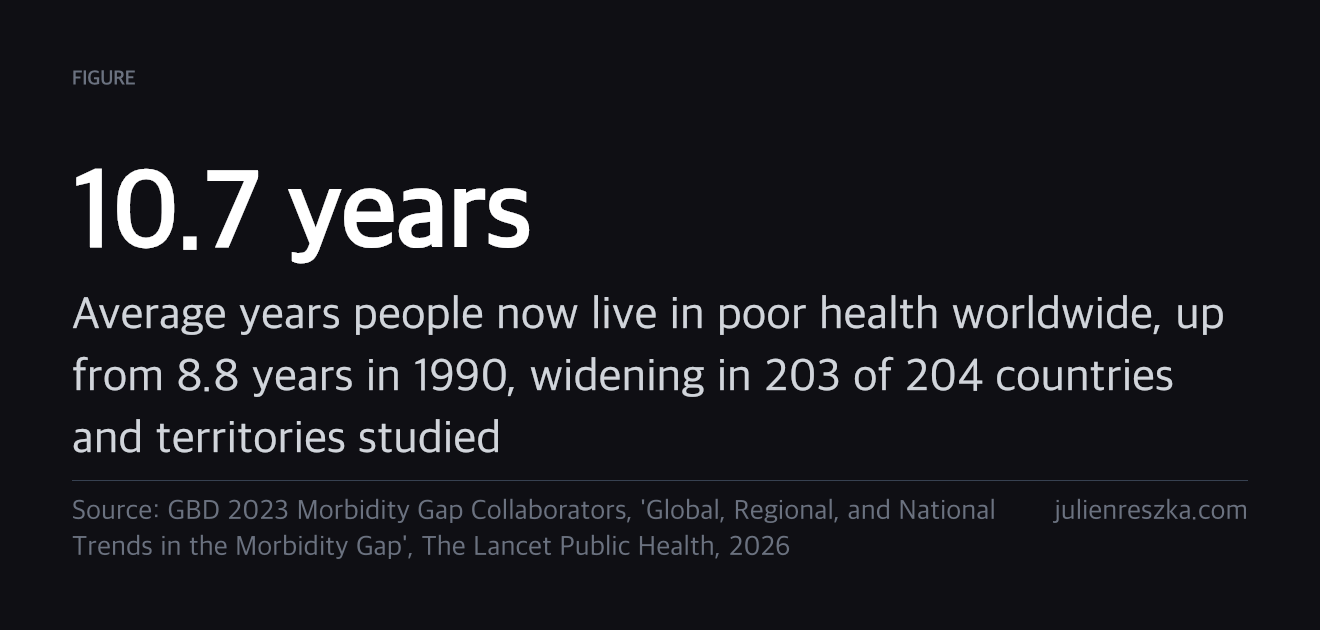
Between 1990 and 2023, global life expectancy rose from 64.6 to 73.8 years, but healthy life expectancy rose more slowly, from 55.9 to 63.1 years. The morbidity gap — years spent sick rather than dead or healthy — grew from 8.8 to 10.7 years, an increase of nearly 22%, and it widened in 203 of 204 countries and territories, across the entire adult lifespan rather than only its final years. The share of a global lifetime spent in poor health climbed from 13.6% in 1990 to 14.5% in 2023.
Women carry a wider gap than men: 12.1 years in poor health on average versus 9.3 years. The three widest national gaps in 2023 were all rich countries — the United States at 14 years, Australia at 13.9, and Canada at 13.7. The causes are not rare diseases: musculoskeletal disorders led by low back pain, depression and anxiety, age-related hearing loss, falls, and other chronic non-fatal conditions together account for 57% of all unhealthy years worldwide.
The pattern contradicts James Fries' 1980 'compression of morbidity' hypothesis, which predicted healthy habits would compress sickness into a short window at the end of life. Instead, the data aligns with Ernest Gruenberg's 1977 'Failures of Success' thesis: medicine postpones death without curing the underlying disease, spreading illness across more of adult life. A US county-level study from 2009 to 2019 illustrates this: life expectancy rose half a year to 79.1, while healthy life expectancy fell 0.3 years to 66.2, with the sharpest declines among American Indian and Alaska Native populations in the western United States.
The widening gap also has economic implications: with more retirees drawing on fewer workers, and more of those retirement years spent in poor health, the burden on pension and healthcare systems is sharper than dependency ratios alone suggest.