Why your local LLM feels dumber than it is
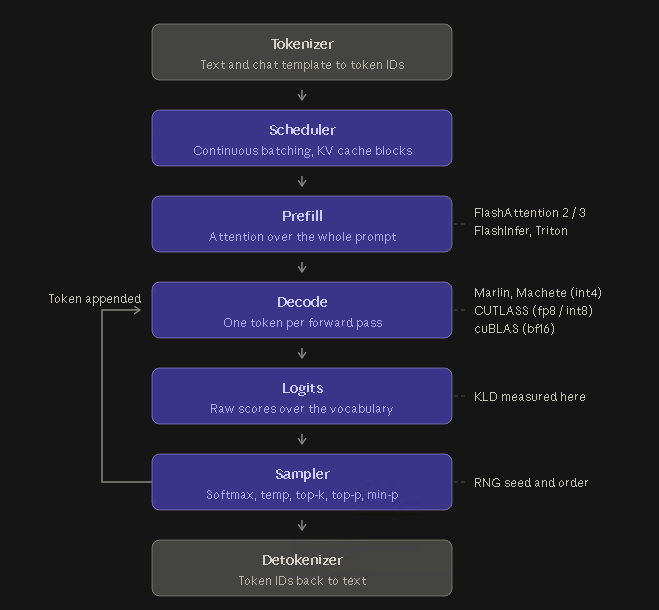
The post begins by addressing the common experience of hearing hype about a model, downloading a quantized version, and being disappointed. The author plans a technical series of experiments to demonstrate how implementation-specific hazards affect inference. They define the 'reference implementation' as the lab's first-party hosting environment, which uses different hardware and software than the typical user's setup.
Every hardware/software stack runs LLMs slightly differently, especially home lab users mixing GPU generations with different instruction sets that execute math differently even for identical weights. The author suggests practical evaluation through standard benchmarks (terminal bench, hle, SWEthis, HELLAthat, MMLU-whatever) that reflect the user's actual workload, warning against zero-shot tests with temperature set to zero because they don't approximate agentic tasks. Long-context tool-calling and domain-specific evaluations are recommended to find weaknesses.
The mathematical explanation focuses on logits: scores for each possible next token, normalized into probabilities, passed through the configured sampler, and detokenized into text. The author notes that model cards on Hugging Face specify exact sampler settings (e.g., temp 1.0, top-p 0.95) and chat templates, and that setting temperature too low can cause models like Qwen to loop in their THINK output. The core message is that no local implementation is exactly like another, so comparisons are only valid on your own setup.