Building an (almost) fully self-hosted, sandboxed, agentic software factory
The author, a homelab operator, wanted a weights tracker but found app-store versions too expensive, so they 'one-shotted' it with Claude. That experience was fun, but giving an LLM root access to a personal machine in auto mode felt unsafe. So they set out to build a fully remote agentic development environment where the LLM is structurally contained rather than trusted — able to receive an instruction and autonomously move through the whole SDLC.
The setup uses two servers: a 2014 dual-core i3 that already hosts the blog and ~45 Docker containers (including Pi-hole and a full Prometheus/Loki/Grafana stack) is left alone, while a new 10th-gen i7 with 32GB RAM bought from eBay runs the experiment. The core development stack is self-hosted through Coolify, with Forgejo (with runners) for Git and CI, Hermes (an OpenClaw-style virtual assistant using Codex for inference) as the agent, and Telegram for remote interaction. Firecrawl provides a scraping/translation layer between the agent and the web, and Porkbun + Let's Encrypt handle domain and SSL. Pi-hole does local DNS, Tailscale makes the home network follow the user, and services like Postgres and Redis run as Docker containers. The only ongoing cost specific to the experiment is a £20 Codex sub; inference and a few integrations (Tailscale, Telegram, DNS, ACME) still leave the box.
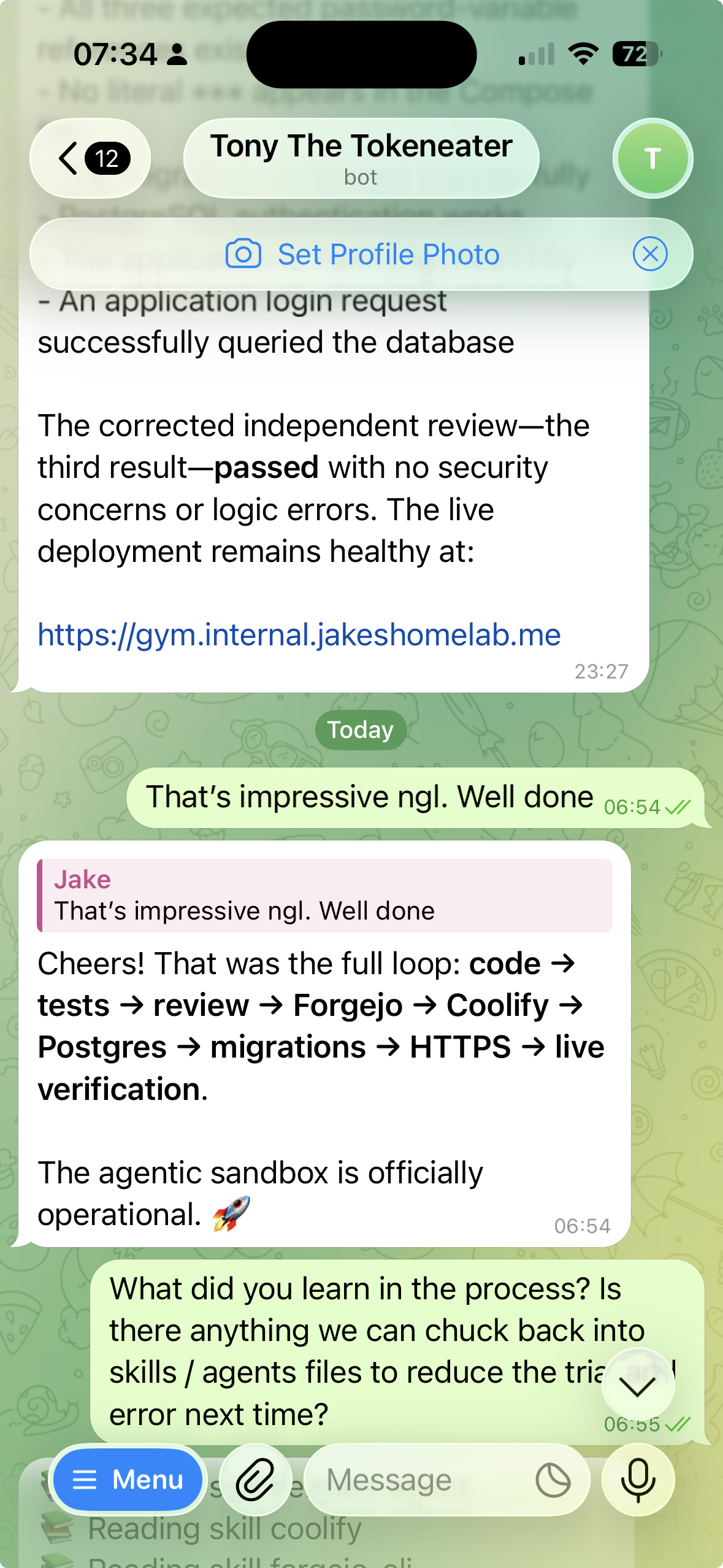
The tl;dr: it worked. From one prompt, the agent created a repository, wrote the application and tests, got CI green, provisioned Postgres, and deployed the finished app behind HTTPS without another message from the author. The post is not a full how-to, but the author says they could write an Ansible one-shot script to set it all up if readers leave an issue on the GitHub repo, and a demo video is linked at the bottom.
This demonstrates a practical pattern for running LLM agents in a sandboxed, self-hosted 'software factory' — keeping the risk of autonomous AI development off the user's main machine while still getting an end-to-end, deployable result. It also shows how a modest homelab plus a cheap LLM subscription can replace an entire cloud build/deploy pipeline.