Inside vLLM: Anatomy of a High-Throughput LLM Inference System (2025)
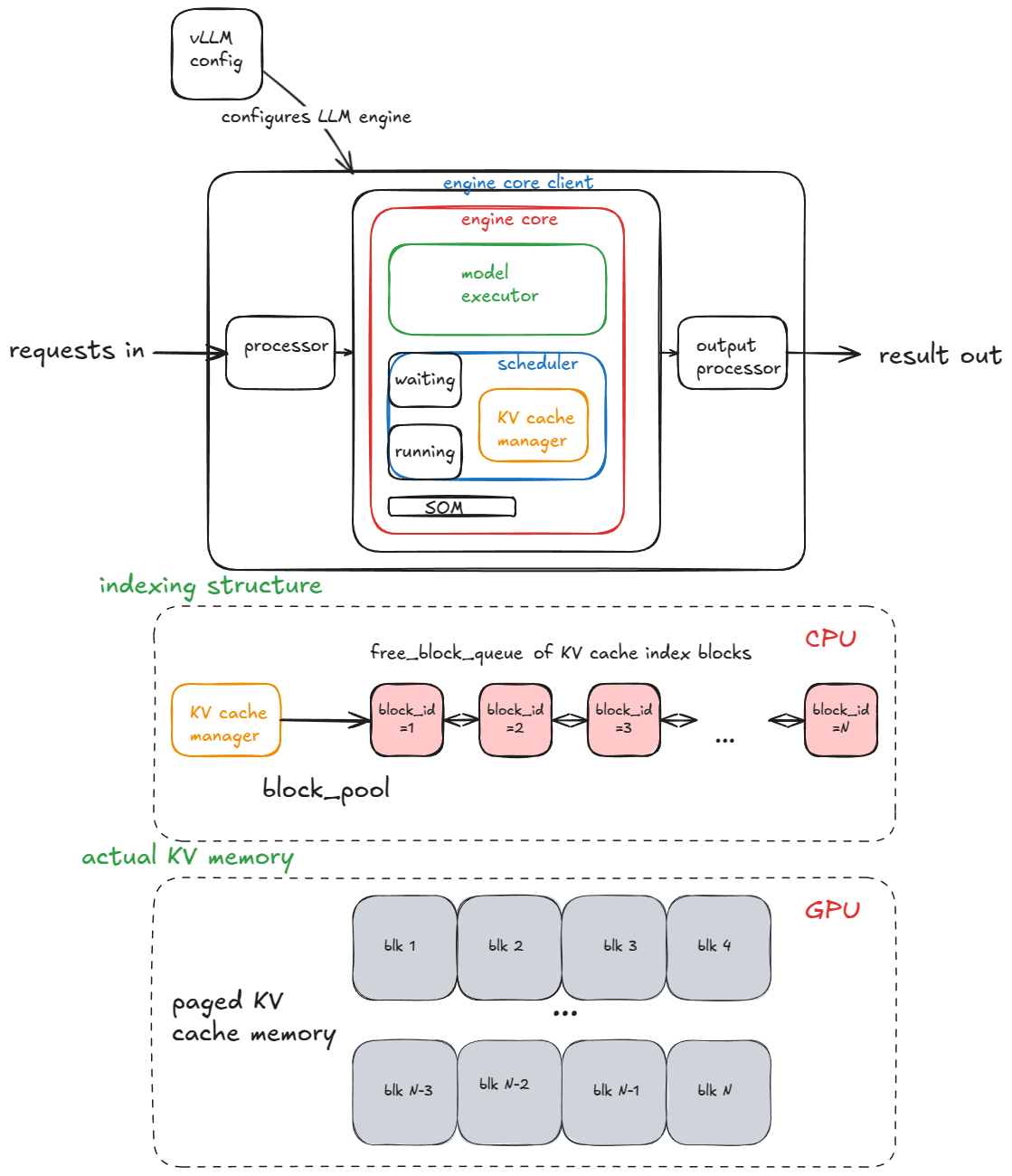
vLLM is a widely used open-source library for high-throughput LLM inference. This post, the first in a series, takes an inverse-pyramid approach: it starts with a broad view of the complete system and then layers in details, aiming to build an accurate high-level mental model without overwhelming the reader. The analysis is based on commit 42172ad from August 9th, 2025, and focuses on the V1 engine, with some exploration of the deprecated V0 engine for historical context.
The post is structured into five main parts: the LLM engine and engine core (fundamentals like scheduling, paged attention, and continuous batching), advanced features (chunked prefill, prefix caching, guided and speculative decoding, disaggregated prefill/decode), scaling from single-GPU to multi-GPU execution, the serving layer for distributed/concurrent web scaffolding, and benchmarks/auto-tuning for measuring latency and throughput.
The core section introduces the LLM engine as the fundamental building block, which by itself enables high-throughput inference but only in an offline, synchronous, single-process, single-GPU setting. A running example demonstrates offline inference with TinyLlama-1.1B-Chat, using environment variables to configure V1 engine and single-process execution. The engine constructor instantiates the vLLM config, processor (turning raw inputs into EngineCoreRequests via validation), and other components that will be explored in subsequent sections.
The post then plans to build up step by step to an online, asynchronous, multi-GPU, multi-node inference system. It targets anyone curious about how state-of-the-art LLM engines work, as well as potential contributors to vLLM, SGLang, or similar projects.