OpenAI's GPT-6 Astra on ARC-AGI-3
ARC-AGI-3 is a benchmark for studying agentic intelligence through novel, abstract, turn-based environments. Agents must explore, infer goals, and build internal models of environments to effectively plan actions without explicit instructions. It is the third generation of the ARC-AGI series, which measures the “residual gap” between current AI and AGI—defined as a system’s ability to acquire any skill a human can, as efficiently as a human can. ARC-AGI-3 tests four components of agentic intelligence: Exploration, Modeling, Goal-setting, and Planning and execution. Humans can solve 100% of the environments.
GPT-6 Astra was evaluated on ARC-AGI-3 Semi-Private using two harnesses. The Standard harness enables the model to carry forward notes it chooses to keep with it throughout the environment. The Provider Adapter harness preserves opaque reasoning state between requests and uses compaction for longer conversations, allowing the model to reuse prior work. A key behavior observed in GPT-6 Astra was its ability to turn unfamiliar environments into compact symbolic world models, representing game mechanics as logical rules and developing its own domain-specific language shorthand to track state and plan actions.
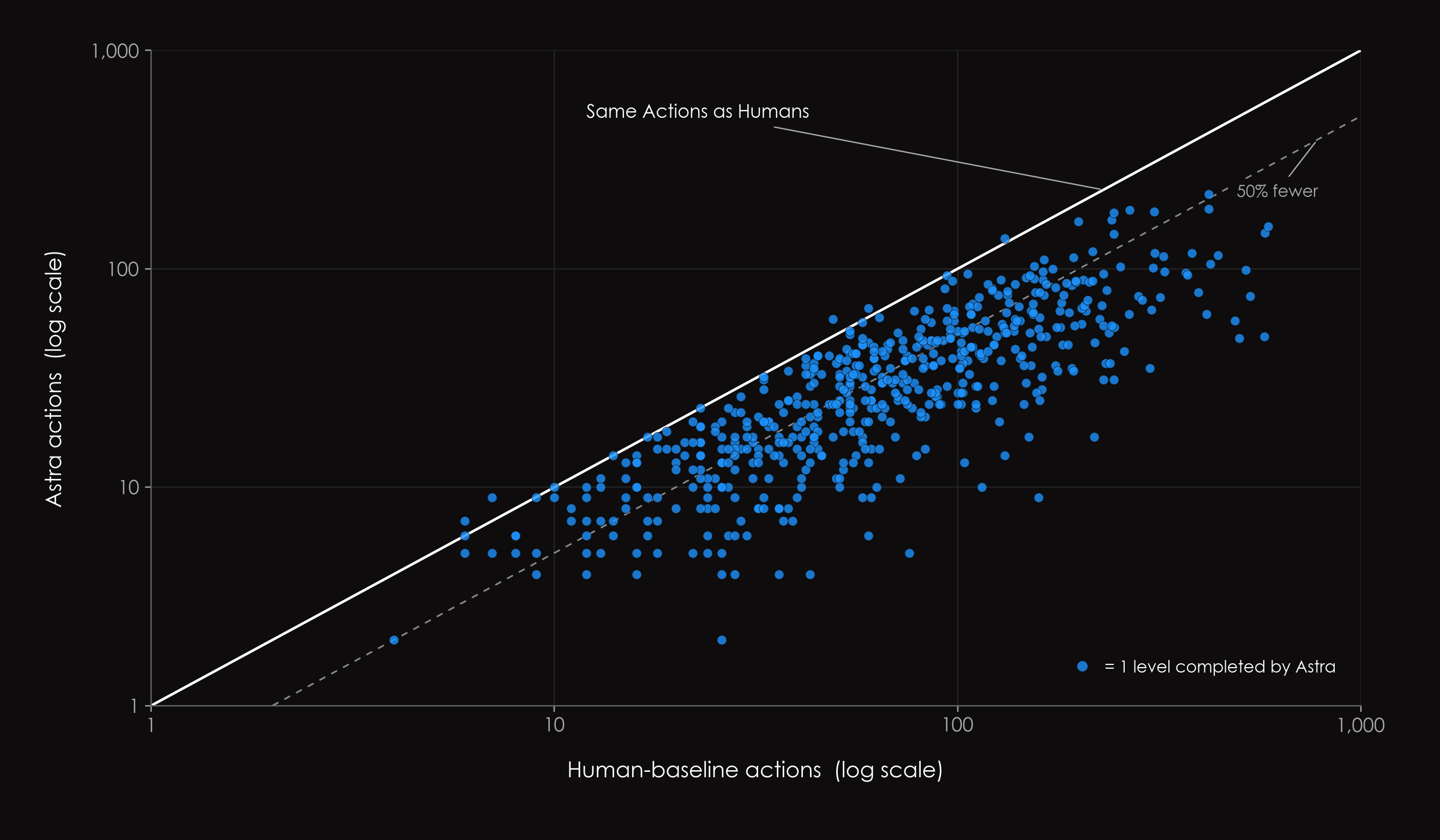
The results show that Astra (max) scores 62.7% on ARC-AGI-3 Semi-Private for $26K with the Standard harness, and Astra (high) scores 99.9% for $19K with the Provider Adapter harness. GPT-6 Astra surpasses the human baseline in action efficiency, using fewer actions than the median tested human on 96% of levels. Higher reasoning levels generally cost less because Astra solves games in fewer actions, reducing the total number of model calls and tokens.
These state-of-the-art scores with both harnesses demonstrate that GPT-6 Astra is pushing toward human-level agentic intelligence in novel, abstract environments. Its efficient world-modeling behavior is a key driver of both high performance and low cost, while the benchmark’s calibration against humans suggests there is still a residual gap to close.